Sunday, August 5, 2012

Crossing Over: Walking from Chicago to Indiana Dunes

This is an excerpt from a longer work that recounts and reflects on urban walking and traveling in edgelands and environments within cities and rural areas that we know only from driving or cycling through them. For years, I've lived in Chicago and hiked in so-called natural areas in and around the city of Chicago, particularly the glorious Indiana Dunes and National Lakeshore, one of the few urban national parks in America. After a month hiking in the UK, where I hiked in and out of cities into rural farms and pastureland and then up into the highlands, moors, and coastal trails, I returned to Chicago wondering why there was no way to walk from the City's great Lakefront park to this National Park visible from my own beach side apartment in Rogers Park. So two years ago, I set out to find that trail, trying to stay close to the lake where there was once a trail used by animals, Indians, and then early trappers and fur traders. The 62 mile pilgrimage of sorts took two long days. I'm hoping to post on this blog some sections from what I hope will be a book that blends my travel account, reportage on some of the current environmental issues facing the region I walked through, and some of my own thoughts on walking and how it affects our perceptions, particularly about our relationship to the landscape where we live.


 “Through me is the way into the woeful city . . .” Dante


            I entered Indiana by descending into the earth, as I followed Highway 41 under a defunct railroad bed and the towering pillars of the Indiana Toll Way.  What was left of the decrepit viaduct appeared to be held together by its last coat of paint; who knows when that might have been. The railroad bed had eroded into an earthen mound and out of the tracks a linear garden of man-sized weeds and sunflowers bloomed.  Cars slowed to a crawl as they had to bounce over craters or weave around chunks of concrete.  To avoid the mounds of slimy pigeon shit that covered the narrow walkway, I, too, had to slow my pace. But at least the tunnel provided a break from the heat.   

  In the last mile, I’d witnessed the history of America’s transportation system, generation upon generation, corroding all about me from sidewalks, to roadbeds, to bridges, to railroads. And yet, I was enthralled by what I’d really never bothered to see—the beauty of rust and ruins.  Here, passing from Chicago’s South Side into Hammond was a world left to itself, off in the corner and out of the way, except of course for those who had to use it.

            Emerging back into the light, the patriotic town fathers of Hammond have placed a World War II tank, fenced in neatly if not a bit cheaply with painted white rocks, in a triangular memorial that bisects Indianapolis Blvd and Highway 41.  The gun was aimed at Chicagoians slinking back with their full tanks of cheap gas and cartons of cigarettes and booze, hoping to avoid the city’s sin taxes. Or the hordes that spent pension money on the penny slots at Indiana’s shrewd schemes to get Chicagoians to provide some tax relief for its crumbling cities.  

An old man, filthy and over-dressed with a thick coat, staggered down into the underpass as I walked up, hoping for some change. But I dropped my eyes to avoid his, pitching coins in my pocket he needed more than I did. A bad omen, I thought, a fellow Hoosier, too. So I turned to go back and offer him a few coins for safe passage, but he’d disappeared into the darkness heading back to Chicago.

It’s hard to imagine a place less likely for a park than underneath the Indiana Toll Road, but as I made my way into Hammond, there was a concrete slab with two steel park benches in a cozy corner, a trash can, and a withering row of tangled shrubs, inviting me to take a break under the canopy of concrete.  And If I wasn’t dazed from the heat and low on blood sugar, and not panicked about how I was ever going to cover eight more miles to the edges of Gary before night fall, I would have parked my ass down and marveled at the sheer wonder of life under an expressway.  I mean when do you have a chance to study the sculptural wonder of concrete and rebar, and the engineering of something as massive as an expressway with pillars the size of a red woods, from this angle?  And the roar! Like a waterfall of noise and exhaust flowing down on top of you. The wheels and tons of weight pounded each time an eighteen wheeler bounced over top, shaking the ground so that I could feel the vibrations coming up into my groin and belly.  Nonstop. Never ending! Billions of tons going east, billions going west, day after day, year after year.
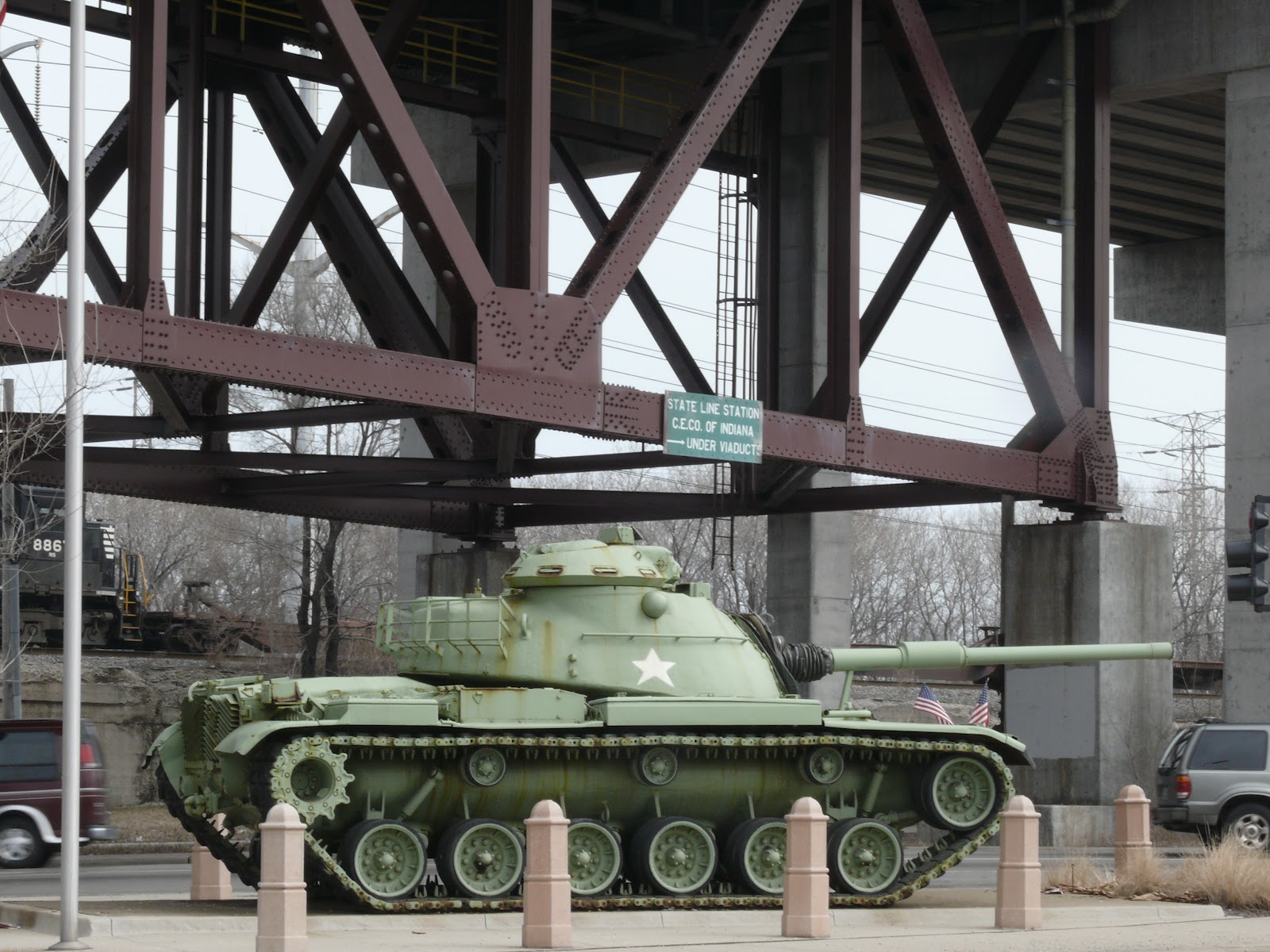
Like the Skyway a couple miles back, these structures that we take for granted were built by people, ironically out of the materials forged and mixed in their backyards by their uncles and brothers. These architectural behemouths, like nearly everything made in Chicago, it seems, are icons not only to the grand designs of architects and the largesse of capitalists but monuments to the people who built them and ironically who must swallow the poisons that come with them.  

Then, suddenly, darting from under the concrete and steel lattice, and over the trees of heaven drooping like palm fronds, came a squadron of birds. Wingless, it seemed, they rocketed in loose formation, out over the evening traffic, dipping and diving around billboards and over the tops of houses. What were they? Pigeons? Not likely, as two more jetted by, I took out my binoculars and nearly jumped out into traffic:  Yes!  The famed green parrots of the South Side.

My next challenge was to cross the highway. But how? Where? Cars shot down the off ramp, barreling over my shoulders, making it hard to think.   Fortunately, a traffic light ahead, actually made all six lanes stop for a whole half a minute for this endangered species with his backpack and hiking shoes to parade across. Pity the poor pedestrian across the world, who has it much worse, in places like West Africa where thousands die each year along the city roads, an inordinate number of children and older women, hoping to cut a few minutes off a grinding day of carrying goods or water home, with no place to cross.  Once, I recall, stupidly trying to cross a river of motorbikes, cars, bikes, and rickshaws in Chennai, India, with luggage no less, thinking surely I could get across a road no wider than my neighborhood street, but had to walk down the road and wait for nearly a half hour like everyone else, at a traffic light that stopped seemingly only every ten minutes for the crowd to scurry across before the damn of traffic burst.

But, my sights were set, I was heading for those golden arches of corn starch, happily lit ahead over the empty lots and brake and muffler shop.  I’d not eaten in eight miles or so, at a stand on the beach in Hyde Park, chips and some kind of barbeque something I didn’t even really look at before swallowing it in two bites.

I’m partial to McDonald’s. Why? I don’t really know. Forty-five years of French fries might have something to do with it, give or take a few years living abroad, where, I must admit, I have found myself in line on the Champs Elysees looking down at my feet and ordering in my best bad French une grande milkshake and pommes frites, si vous plait.

When McD’s came to my hometown in 1967, there was a sense of palpable pride: our factory town of thirty-five thousand souls had entered American middle class luxury, or so we believed.  The future had finally arrived: frozen foods, moonshots, color TV, and fast food.  Those dingy downtown diners (one of which my aunt actually owned) were over.  Who wanted a tenderloin as big as your face, or pie that someone actually made and served with ice cream from the town creamery?  We begged my dad to just drive by, so that we could peer into the glowing florescent lit miracle that we knew, we hoped, we prayed, would eventually bring us, maybe even a mall with a K-Mart. (And it of course eventually did.)

At the counter, of course there was a family of Hispanics ordering via their 10 year old daughter, who along with the counter girl switched back and forth from Spanish to English to Spanglish.  But I was just happy to be in AC, after all, I was the foreigner, as Hammond is home to yet another wave of America’s immigrant story, with nearly half of its population now from Mexico.  I settled for a benign fish combo with a chocolate shake.

As soon as I collapsed into my chair, my legs felt like sand bags pouring out onto the floor.  The bottoms of my feet burned.  I stared for a few moments at my food, the corn starch display boxed and bagged ready to eat.  Then, the next thing I knew, I was shaking the box of fries for every last crumble and sucking up the final straw full of sucrose. Blissfully buzzed by sugar and carbohydrates, I thought of putting my head down on the table, but knew I’d better not risk it.

Instead, I stared out the wide windows at the industrial landscape of Hammond, Indiana.  “The City in the Middle of It All,” as a sign proclaims as you enter.  Indeed it was, corporate giants processed, forged, and belched in every direction:  Cargill, Dove, BP, Arcelor Mittal, US Steel, State Line Power, and miles of tank farms. (And that’s only what I could see.)  On the other side of the highway, three squad cars had cornered a man in his van in front of a shuttered cigarette outlet.  Behind this silent drama, a long line of double-decker containers awaited their next load, a reminder of the area’s historic role in the railroad business, where once almost every major rail line in America passed through.   Many of the cars were tagged with colorful signatures of protest; a night’s work for artists along the routes of America’s manufacturing ghost towns. Beyond the wall of artwork, where the lake should be, was the brick bastion of State Line Power Company spewing forth from its coal-burning furnaces as if it were 1970, as it has successfully avoided for years the EPA’s demands to comply to the Clean Air Act. (Indiana itself only last year finally got taken off the list of states who’d not been able to comply!)  Beside it, running a half mile along the lake, hills of coal, higher than the tops of the nearby stands of cottonwood, await alchemical transformation form fossils to megawatts for the people of Chicago.  

But what caught my eye was the webbing of electrical lines and the towers that carried them, giant black praying mantis on their hind legs marching off into marshes behind me and over the industrial lands to the south and east, scores of them. Why hadn’t I noticed how many and how magnificent they were? Were they beautiful in their patterned sequence, black against the fading pale light over the petroleum pipes and plumes of fire of the refinery?  How was I seeing this all for the first time if I’d passed over it hundreds of times before? Was I just too tired to care how ugly it really should look? Or had my perception shifted from having walked all day and landing here as if it were someplace I’d never known, a territory that existed inside the city I thought was mine?  


Saturday, April 21, 2012

The Trash Man of Hollywood Beach

"Anarchism is not a romantic fable but the hardheaded realization, based on five thousand years of experience, that we cannot entrust the management of our lives to kings, priests, politicians, generals, and county commissioners."  
Edward Abbey

Hollywood Beach, Chicago


Perhaps you’ve seen them in a park or along a shore near where you live—the ones   stooping down and picking up trash, a plastic bag or two or three hanging from an arm or attached to a belt loop. Maybe they have an old dog tagging along behind them, but usually they’re alone, and older. Almost always men. (Though I’ve seen women, too.)


Montrose Harbor Dunes
You wonder at first, are they with some group doing community service of some kind? But no, they’re there almost every day.  They’re not to be confused with the beachcombers—the ladies who salvage bits of lake-polished glass. Or the men in their infernal metal-detectors with earphones, hoping to turn someone's loss into treasure.  No, these are of another eccentric tribe that beaches and city parks create--the people who pick up trash, the trash men, as I call them.


Whiting, Indiana Beach (British Petreleum in Distance
I’d met one man a few years ago on a walk I took to Indiana. I’d seen him often, watching him from afar, a short stocky man, with weather worn clothes and hat, old tennis shoes, glasses, energetic for an older man (maybe late 70’s or early 80’s). He seemed almost in a hurry as he tottered Chaplin-like, balancing two plastic bags on each sun-tanned arm, as he went about his daily chore. I’d kind of felt sorry for him as I have others like him I’ve seen, eccentrics, I imagined, lonely, widowed, no doubt suffering from mild obsessive-compulsive disorder, having, needing to make their morning rounds. Or so this is how I explained these types of aging men I've seen.

It was an extraordinary beautiful summer morning along Chicago’s lake front and I was in an expansive mood, under the spell we put ourselves into when we are on a purposeful journey. Walkers and hikers know what I mean. We set ourselves a goal and define it as something of value, and suddenly we see the world anew.   So when he appeared as I thought he would, I went right up to him and introduced myself and told him (almost as a kind of confession). I had a camera around my neck. I told him I’d seen him so many times gathering trash and wanted to thank him for it. “You inspire us out here,” I said, gesturing to the Polish ladies getting ready to take their morning swim.

He stammered. And I realized I’d scared him. He was older than I thought, but as he talked, his body seemed to become younger and more animated. “Please don’t take my picture, I don’t’ want any publicity, I’m nobody important. I just come and do this because I like to help. Keep the beach clean. Make it safe.”

“How long have you been doing this,” I asked as he waved at some older couple he knew who passed.

“I’ve been coming . . . a long time. Over twenty five years. I can’t remember.”

He went on to tell me the story of how he’d begun his cleaning up of the beach. His daughter apparently cut herself badly on a piece of glass and with the help from the lifeguard’s bandages he got her to a hospital. “It was terrible," he said as if still seeing her foot, shaking his head, "so much pain and blood.”

After that, he told me he felt it was his duty to clean things up. "You know, it could happen to some other children, stepping on the glass, they can’t see it in the sand. They're children. I just thought I should do it.”

But he obviously cleans up more than glass, and now he hits two beaches, Hollywood and Foster, a good half mile or more of beach and lakefront.

And then he was off down the beach, heading for another plastic bag, a solitary Starbucks cup rolling in the surf.

Chidago Lakefront, between Hollywood and Foster Beaches 


It’s Earth Day, and as usual school kids everywhere will be dragging plastic bags around on beaches and parks, neighbor groups tidying up neglected lots and planting trees, and the Sierra Club will be out somewhere battling invasive species for the day. On Hollywood Beach, my hunch is a man will be out there feeling somewhat more at home with so many following his lead.

The other week I was walking along the lake shore, a bit overwhelmed with the world and "the cruelist month" as Elliot called April, and I saw some trash and naturally picked it up, then a few more yards down, a black plastic gently swayed as the waves flowed over it a foot below the water.  I looked around to see if anyone was watching me (why I have no idea), and I took off my shoes and waded into the freezing surf and retrieved it. I walked on, picking up this and that, scattered on the surf.  I was glad to have something to do to eclipse my manufactured melancholy. 


Montrose Harbor Beach, Chicago
I could become a "trash man" like the man at Hollywood Beach. I’d have to practice, but I could do it.


Thursday, July 28, 2011

Walking Among The Beach Combers of Chicago


What makes a person wander along a beach fingering along through the flotsam in search of treasures that have washed in with the waves?  Are these people born this way? Has something happened to them to make them seek the solitude of the morning surf?
Though the beaches along the southern shores of Lake Michigan do not have the majesty of sea coasts, they nevertheless draw out the beachcomber in the Midwesterner. On my walks along the beaches from Chicago to the Indiana Dunes, I often come across this peculiar breed. They are of all colors and sizes, of every class and physical condition. Once, I saw a woman dragging her tank of oxygen through the rocks, as she sifted through the sands looking for glass. They are often older, but among children you can see the same instinct to marvel and collect, finding in a spent balloon or odd bit of driftwood or colorful stone something to decorate a sand sculpture.

The beach comber apparently has its origins among British sailers, who, exhausted, banished, or simply  intrigued, stayed in ports and islands in the South Seas and in other distant shores far from home. There, they learned to live off what they could find on the beach, fishing, collecting, making a hut, co-mingling among the native people, and returning on the next crew or deciding that this life and the ways of these people were far superior than the harsh life of a sailor. I suspect that the beachcomber is part of a world wide tribe of people.  And I’m not so sure that a beach comber even needs a beach to do his wandering and sifting through the debris of man and nature. The found art folk, the alley wanderers, dumpster divers, etc. My mother, who suffers from Alzheimers, walks around her yard and garden every day and picks up sticks that have fallen. Is that not a form of beachcombing?  We come from a long line of hunters and gatherers, and some of the earliest archeological sites are along the shores of lakes in Africa.

But as I walk, I’m always looking for the beachcombers, to see what they’re doing, what they’re collecting, what they’ve got in that special bag by their side. Often they are simply picking up trash, the good Samaritans of the beach. (There are many of these in Chicago, men mostly, for some reason.) I met a man who'd been picking up trash for over 25 years on Hollywood Beach. He told me: "My daughter cut her foot out here once on a piece of glass, so I just think maybe I can do some good." On the Chicago lake front there are no real shells but there is glass, shards polished by the surf, and this occupies many of us beach combers.


“I’ve got pounds and pounds of them,” a woman told me last week, as I was about to go for a swim. She was dragging a stick through piles of tiny tumbled lake stones by Pratt Pier on Chicago’s northern most  beach. “I pray while I do it,” she said. “It keeps me sane,” she smiled, showing me her finds. “I make things with them. Prayer glasses, you know, for candles.” She showed me her legs, scared with little dots up and down her ankles. “I got titanium bones, got rear-ended three times. Blessing in disguise, though. I pray for these rage road people, cause I was like them once.” She leans on her stick, then bends back down and picks up a thumbnail shard of green glass.

“You’ll think this is crazy,” I confessed to her, “but I collect brick and concrete stones.” I picked up  a piece of concrete that had been tumbled into a polished stone of conglomerate pebbles.  “Water is a powerful thing,” she said. “I’ll look for some for you. I’m collecting Warsaw granite, see,” she showed me a garnet colored stone, wet and gleaming in her black fingers. “I know this guy who picks up the trash here. His mother’s gravestone is made of the same granite. I give him all I got.”

I walked on down the beach, thinking of her, ambling there in the surf, picking through the rocks, as the waves came and retreated. 


Wednesday, June 15, 2011

MARCHING THROUGH 30 YEARS OF AIDS

“The more we lack the courage and the will to act, the more we condemn to death our brothers and sisters, our children and our grandchildren. When the history of our times is written, will we be remembered as the generation that turned our backs in a moment of a global crisis or will it be recorded that we did the right thing?”— Nelson Mandela, Tromso, Norway (11 June 2004)
Zackie Achmat and AIDS activists at AIDS Conference in South Africa, 2000


Thirty years ago, I heard the news on a gerry-rigged short wave radio with its antennae attached the top of my thatched roof. The BBC announcer described a mysterious disease that affected the immune system, which apparently only infected gay men and some Haitian immigrants. The disease was called AIDS. It was 1981. I was in the Peace Corps in West Africa working with women on vegetable gardening. I heard the report again and again that day, a news junky even then. Each time I became more and more alarmed and scared.
Fifteen years later, in a public health clinic in Chicago, I sat across from a social worker. She passed me a slip of paper with three words on it:  my first name, my last name and underneath in a dot matrix blur: POSITIVE. I stared at it for what seemed like a long time, thinking first that it meant, good news, positive, as opposed to negative, bad. Then, as my mind struggled to accept the diagnosis, I actually had the thought that I was not, Michael McColly.  After all these years, this was not my name. Who was this man? Not me.

But it was.

On Northwestern Campus, Evanston
In 2000, I was back in Africa, marching along with tens of thousands of South Africans, people like me living with HIV, as well as activists and health workers from around the world who were attending the International AIDS conference in Durban, South Africa. I wore this t-shirt, walking through the streets of Durban, proudly raising my voice with the others, chanting slogans to wake the people of the world to the injustice of drug companies and governments blocking access to the millions in need for treatment. What I remember that day were the throngs of young people, bussed in from around South Africa, from Soweto, from Cape Town, from rural areas where rates of infection were in some places nearly 30 percent.  They were so boisterous, chanting, laughing, arm-in-arm, finally able to be out in the open, unafraid, their heads held high, marching at the front of the protest.

Then as now, millions still have little access to the necessary drugs and care that have kept me and thousands of others free from the ravages of this insidious retrovirus, which infiltrates and copies itself onto healthy T-cells.

Last week, I pulled this t-shirt out of my drawer. (I’d worn it only once since that day at talk I’d given  on AIDS activism, which was the subject of my last book, The After-Death Room.) I decided to wear it for a few days in honor of all of those who have been affected by HIV as well as all of those unsung healers, care-givers, health workers, activists, scientists, and artists who’ve given so much to keep the world aware of this disease.  I wore it to readings, while teaching, while walking through campus, while walking through the streets of Chicago, and through my own neighborhood. It was my mini march of memory and protest.  Everyone wears t-shirts to support causes or proclaim affiliations or make jokes or call attention to something. But when I put on this shirt with HIV POSITIVE in bold purple, I felt that old anxiety of fifteen years before, an anxiety that I’m reminded millions feel every day, terrified for not only their health but of others finding out. People are still jailed, beaten, and murdered for living with HIV.  Two men boldly asked me why I was wearing it. A few smiled. But most still rushed by, one young man on Michigan Ave, blurted, as if I might not have ears, “Eeww, look: HIV!”

HIV and AIDS still threatens the lives of some 30 plus million people. Most of those who live with HIV don't know they have the disease, as they are too afraid to find out or have little access to health care. Most of the people with HIV are poor, young, female, and vulnerable to other diseases and the world's injustices.  The losses attributed to this disease are incalculable. The fears are still palpable and destructive. Yet, this disease has also awakened the world that we share this planet, and the health of each individual affects us all.  Whether it is HIV, TB, war, toxic chemicals, greed, racism, hatred or hypocrisy, we all suffer. But we all triumph when even one of us turns toward the fight and marches on.  I am alive because of many before me, from all over the world, who did not back down.